
Pharmacognostic, phytochemical, and antioxidant evaluation of ethanolic extract of Tinospora cordifolia using ABTS assay
DOI:
https://doi.org/10.5530/ajphs.2025.15.89Keywords:
Giloy, Tinospora cordifolia, ABTS, AyurvedaAbstract
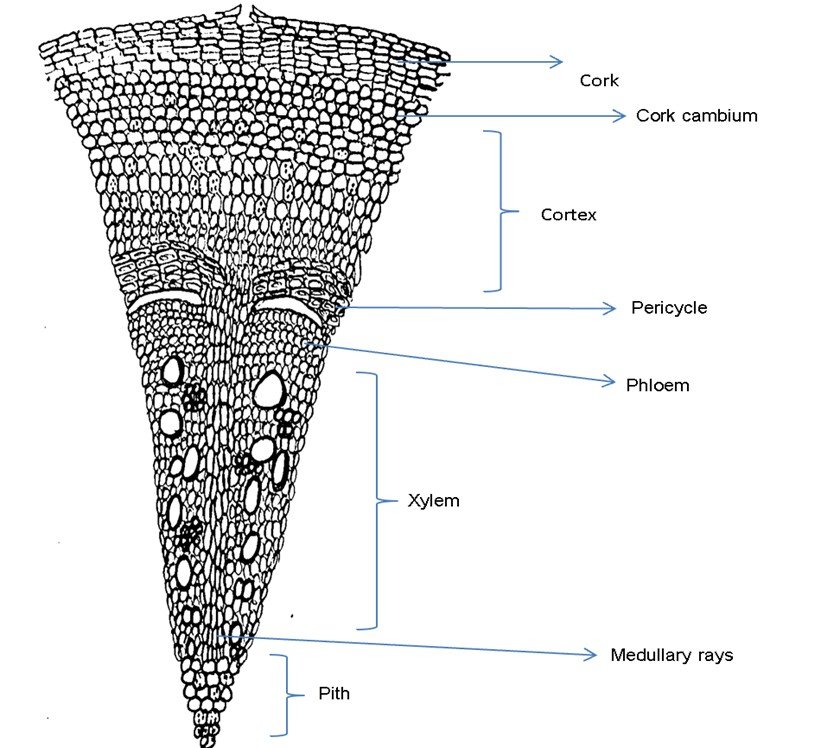
Objectives: Tinospora cordifolia is a key medicinal plant in Ayurveda, traditionally valued for its immunomodulatory, anti-inflammatory, and antioxidant properties. This study aimed to establish its pharmacognostic characteristics, phytochemical profile, and in vitro antioxidant potential, providing scientific support for its traditional therapeutic uses. Methods: The plant material was authenticated through macroscopic, microscopic, and powder microscopy examinations. Preliminary phytochemical screening was performed using standard qualitative tests. Thin-layer chromatography was employed to separate and identify major phytoconstituents. Antioxidant activity of ethanolic extract was assessed using the ABTS radical cation decolorization assay, with results expressed as percentage inhibition and compared to ascorbic acid as a standard. Results: Macroscopic and microscopic studies revealed characteristic features, including a heart-shaped leaf, cylindrical stem with prominent lenticels, and stellate trichomes, confirming the identity of Tinospora cordifolia. Phytochemical screening revealed the presence of alkaloids, flavonoids, saponins, glycosides, tannins, phenolic compounds, and terpenoids. TLC showed multiple spots, with a prominent spot at Rf 0.6, suggestive of berberine or related isoquinoline alkaloids. The extract exhibited dose-dependent ABTS radical scavenging activity, with maximum inhibition of 55.11% at 2000 μg/ml compared to 92.55% by ascorbic acid at the same concentration. The established pharmacognostic standards ensure the authentic identification of Tinospora cordifolia. Conclusion: The presence of diverse bioactive secondary metabolites and moderate antioxidant activity scientifically support its traditional use as an immunomodulatory and therapeutic agent, warranting further pharmacological and clinical investigations to develop novel herbal therapeutics.
References
Bisset, N. G., & Nwaiwu, J. (1983). Quaternary alkaloids of Tinospora species. Planta Medica, 48(08), 275-279. https://doi.org/10.1055/s-2007-969933
Bharathi, C., Reddy, A. H., Nageswari, G., Lakshmi, B. S., Soumya, M., Vanisri, D. S., & Venkatappa, B. (2018). A review on medicinal properties of Tinospora cordifolia. International Journal of Scientific Research and Review, 7(12), 585-598.
Boro, A., Sujatha, K., Abidharini, J. D., Pallavi, P., Prabhu, J. P. A., & Anand, A. V. (2024). Evaluation of the Antioxidative and Qualitative Properties of the Tinospora cordifolia. Free radicals and antioxidants, 14(2), 126-130. https://doi.org/10.5530/fra.2024.2.13
Chamandy, A., Zhao, M., Rammal, H., & Ennahar, S. (2022). Hyphenated LC-ABTS.+ and LC-DAD-HRMS for simultaneous analysis and identification of antioxidant compounds in Astragalus emarginatus Labill. extracts. Journal of Pharmaceutical Analysis, 12(2), 253-262. https://doi.org/10.1016/j.jpha.2021.09.008
Chaudhary, A., Das, R., Mehta, K., & Mehta, D. K. (2024). Indian herb Tinospora cordifolia and Tinospora species: Phytochemical and therapeutic application. Heliyon, 10(10). e31229. https://doi.org/10.1016/j.heliyon.2024.e31229
Choudhary, N., Siddiqui, M., & Khatoon, S. (2014). Pharmacognostic evaluation of Tinospora cordifolia (Willd.) Miers and identification of biomarkers. Indian Journal of Traditional Knowledge, 13(3), 543-550.
Kareppa, M.S., Jangme, C.M., & Patil, A.R. (2025). Phytochemical Investigation and HPTLC Screening of Tinospora Cordifolia leaf Extract. Journal of Neonatal Surgery, 14(24S), 747-752.
Kaur, G., Prabhakar, P. K., Lal, U. R., & Suttee, A. (2016). Phytochemical and biological analysis of Tinospora cordifolia. International Journal of Toxicological and Pharmacological Research, 8(4), 297-305.
Khan, M. M., dul Haque, M. S., & Chowdhury, M. S. I. (2016). Medicinal use of the unique plant Tinospora cordifolia: evidence from the traditional medicine and recent research. Asian Journal of Medical and Biological Research, 2(4), 508-512. https://doi.org/10.3329/ajmbr.v2i4.30989
Khatoon, S., Irshad, S., Vijayakumar, M., Choudhry, N., Siddiqui, Z., & Kumar, N. (2018). Pharmacognostic analysis of Tinospora cordifolia (Thunb.) Miers, with respect to Dioecy. Single Cell Biology, 7(175), 2. https://doi.org/10.4172/2168-9431.1000175
Manohar, S. R., Vimala., Priyalatha., Paul, R. Priya. (2018). A Brief Review of Synonyms and Properties of Gudūcī (Tinospora cordifolia (Thunb.) Miers) from Selected Nighantus (Ayurvedic Drug Lexicons). Pharmacognosy Journal, 10(6s). https://doi.org/10.5530/pj.2018.6s.2
Modi, B., Kumari Shah, K., Shrestha, J., Shrestha, P., Basnet, A., Tiwari, I., & Aryal, S. P. (2020). Morphology, biological activity, chemical composition, and medicinal value of Tinospora cordifolia (willd.) Miers. Advanced Journal of Chemistry, 2020, 36-53. https://doi.org/10.22034/ajcb.2020.243751.1058
Mohammad, D., & Malik, N. (1963) A contribution to the anatomy of Tinospora cordifolia. Pakistan Journal of Scientific and Industrial Research , 46-50
Pachaiappan, R., Tamboli, E., Acharya, A., Su, C.-H., Gopinath, S. C., Chen, Y., & Velusamy, P. (2018). Separation and identification of bioactive peptides from stem of Tinospora cordifolia (Willd.) Miers. PLoS ONE, 13(3), e0193717. https://doi.org/10.1371/journal.pone.0193717
Patra, A., Pathela, R., & Satpathy, S. (2016). Comparative pharmacognostic and preliminary phytochemical studies of Tinospora cordifolia. Global Journal of Bioscience and Biotechnology, 4(1), 7-19. https://doi.org/10.12974/2311-858X.2016.04.01.2
Polu, P. R., Nayanbhirama, U., Khan, S., & Maheswari, R. (2017). Assessment of free radical scavenging and anti-proliferative activities of Tinospora cordifolia Miers (Willd). BMC Complementary and Alternative Medicine, 17(1), 457. https://doi.org/10.1186/s12906-017-1953-3
Saha, S., & Ghosh, S. (2012). Tinospora cordifolia: One plant, many roles. Ancient Science of Life, 31(4), 151-159. https://doi.org/10.4103/0257-7941.107344
Sharma, U., Bala, M., Kumar, N., Singh, B., Munshi, R. K., & Bhalerao, S. (2012). Immunomodulatory active compounds from Tinospora cordifolia. Journal of Ethnopharmacology, 141(3), 918-926. https://doi.org/10.1016/j.jep.2012.03.027
Singh, D., & Chaudhuri, P. K. (2017). Chemistry and pharmacology of Tinospora cordifolia. Natural Product Communications, 12(2), 1934578X1701200240. https://doi.org/10.1177/1934578X1701200240
Singh, S., Pandey, S., Srivastava, S., Gupta, V., Patro, B., & Ghosh, A.C. (2003). Chemistry and medicinal properties of Tinospora cordifolia (Guduchi). Indian Journal of Pharmacology, 35(2), 83-91.
Sinha, K., Mishra, N., Singh, J., & Khanuja, S.P.S. (2004). Tinospora cordifolia (Guduchi), a reservoir plant for therapeutic applications: A Review. Indian Journal of Traditional Knowledge, 3(3), 257-270.
Solanki, P., & Rodric, D. (2022). Determination of Berberine and Quercetin in Tinospora cordifolia with the help of HPLC and TLC Methods. NeuroQuantology, 20(15), 5623-5630. https://doi.org/10.14704/NQ.2022.20.15.NQ88566
Spelman, K. (2001). Traditional and clinical use of Tinospora cordifolia, Guduchi. Australian Journal of Medical Herbalism, 13(2), 49-57.
Srivastav, Y., Thakur, G., & Tiwari, S. (2024). Study of medicinal plants: Ocimum sanctum & Tinospora cordifolia, bioresources to characterize bioactive compounds using soxhlet apparatus. Asian journal of Biotechnology and Bioresource Technology, 7(8).23-44. https://doi.org/10.9734/ajb2t/2024/v10i3209
Wani, J. A., Achur, R. N., Nema, R. (2011). Phytochemical screening and aphrodisiac property of Tinospora cordifolia. International Journal of Pharmaceutical and Clinical Research, 3(2), 21-26.
Yates, C. R., Bruno, E. J., & Yates, M. E.D. (2022). Tinospora Cordifolia: A review of its immunomodulatory properties. Journal of Dietary Supplements 19(2), 271-285. https://doi.org/10.1080/19390211.2021.1873214