
Evaluation of Anthropometric Indices and Liver Function Parameters Among Illicit Drug Consumers at The University of Port Harcourt, Nigeria
DOI:
https://doi.org/10.5530/ajphs.2026.16.96Keywords:
Illicit drug use, Anthropometric indices, Liver function, Hepatic enzymes, University studentsAbstract
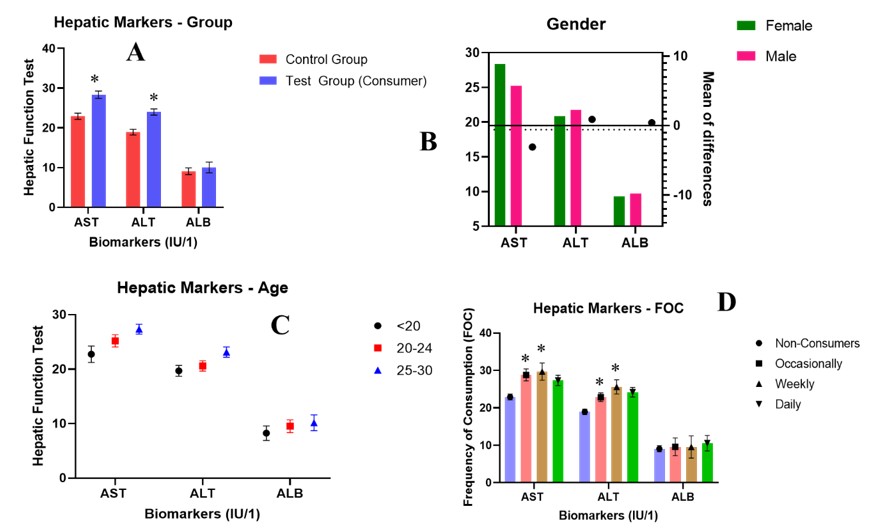
Background: Drug and substance abuse are a global issue, causing mental disorders, death, addiction, and other hardships. The growing problem of illicit drug use among young adults has become a major source of concern, owing to the possible consequences for numerous aspects of health. Objectives: Hence, this study was conducted to evaluate anthropometric indices and liver function parameters among illicit drug users at the University of Port Harcourt. Methods: A descriptive cross-sectional and analytical study design was used, employing well-structured questionnaires to obtain socio-demographic and anthropometric indices and blood samples were collected from ninety (90) participants (45 test and 45 control) for laboratory analysis of liver function parameters using standard operating protocols. Results: Results revealed that individuals in the test group had a slightly higher BMI (24.50 ± 0.71 kg/m²), hip circumference (39.09 ± 0.51 cm), and lower waist circumference (31.98 ± 0.56 cm) compared to controls. Notably, the waist-to-hip ratio (WH-R) was significantly lower in the test group (0.82 ± 0.01 vs. 0.86 ± 0.01, p<0.05), indicating a more favorable fat distribution. This reduction in WH-R was observed across weekly and daily users, all durations of use (1–3, 4–6, >6 years), and most drug combinations. Regarding liver function, the test group showed significantly elevated aspartate transaminase (AST) and alanine transaminase (ALT) levels compared to controls (e.g., AST: 29.92 ± 1.62 IU/l vs. 22.93 ± 0.78 IU/l in 1–3-year users, p<0.05; ALT: 24.55 ± 1.26 IU/l vs. 18.94 ± 0.72 IU/l, p<0.05). AST and ALT elevations were seen across all drug types, frequencies (weekly and daily), and durations, but albumin levels remained unchanged. Illicit drug use among university students is associated with a consistently lower waist-to-hip ratio and significantly elevated liver enzymes (AST and ALT), suggesting altered fat distribution and persistent hepatic stress, respectively. Conclusion: These findings highlight the need for targeted health education, gender-specific interventions, and routine liver function monitoring in this population. Longitudinal studies are required to establish causality and long-term consequences.
References
Aaseth, J., Ellefsen, S., Alehagen, U., Sundfør, T. M., & Alexander, J. (2021). Diets and drugs for weight loss and health in obesity - An update. Biomedicine & Pharmacotherapy, 140, 111789. https://doi.org/10.1016/j.biopha.2021.111789
Cicchetti, D., & Handley, E. D. (2019). Child maltreatment and the development of substance use and disorder. Neurobiology of Stress, 10, 100144. https://doi.org/10.1016/j.ynstr.2018.100144
Clinton, J. W., Kiparizoska, S., Aggarwal, S., Woo, S., Davis, W., & Lewis, J. H. (2021). Drug-induced liver injury: Highlights and controversies in the recent literature. Drug Safety, 44, 1125–1149. https://doi.org/10.1007/s40264-021-01109-4
Di Pasqua, L. G., Cagna, M., Berardo, C., Vairetti, M., & Ferrigno, A. (2022). Detailed molecular mechanisms involved in drug-induced non-alcoholic fatty liver disease and non-alcoholic steatohepatitis: An update. Biomedicines, 10(1), 194. https://doi.org/10.3390/biomedicines10010194
Fischer, B., Blanken, P., Da Silveira, D., Gallassi, A., Goldner, E. M., Rehm, J., et al. (2015). Effectiveness of secondary prevention and treatment interventions for crack-cocaine abuse: A comprehensive narrative overview of English-language studies. International Journal of Drug Policy, 26(4), 352–363. https://doi.org/10.1016/j.drugpo.2015.01.002
Friedman, H., Newton, C., Klein, T. W., & Friedman, H. (2018). Microbial infections, immunomodulation, and drugs of abuse. Clinical Microbiology Reviews, 29(4), 897–929. https://doi.org/10.1128/cmr.16.2.209-219.2003
Garcia-Cortes, M., Robles-Diaz, M., Stephens, C., Ortega-Alonso, A., Lucena, M. I., & Andrade, R. J. (2020). Drug-induced liver injury: An update. Archives of Toxicology, 94, 3381–3407. https://doi.org/10.1007/s00204-020-02885-1
Idowu, A., Aremu, A. O., Olumide, A., & Ogunlaja, A. O. (2018). Substance abuse among students in selected secondary schools of an urban community of Oyo State, South West Nigeria: Implications for policy action. African Health Sciences, 18(3), 776–785. DOI: 10.4314/ahs.v18i3.36
Kashimawo, A. J., Emmanuel, M. E., & Bunu, S. J. (2025). Qualitative determination of sildenafil and tadalafil adulterants in selected herbal aphrodisiac products. International Journal of Traditional and Complementary Medicine, 8(5), 64–71. https://doi.org10.36348/sijtcm.2025.v08i05.002
Mahboub, N., Rizk, R., Karavetian, M., & de Vries, N. (2021). Nutritional status and eating habits of people who use drugs and/or are undergoing treatment for recovery: A narrative review. Nutrition Reviews, 79(6), 627–635. https://doi.org/10.1093/nutrit/nuaa095
Reece, A. S., & Hulse, G. K. (2014). Impact of lifetime opioid exposure on arterial stiffness and vascular age: Cross-sectional and longitudinal studies in men and women. BMJ Open, 4(6), e004521. https://doi.org/10.1136/bmjopen-2013-004521.
Roque, B. R., Faria, A. C., Brito-da-Costa, A. M., Carmo, H., Mladěnka, P., Dias da Silva, D., et al. (2022). Cocaine: An updated overview on chemistry, detection, biokinetics, and pharmacotoxicological aspects, including abuse pattern. Toxins, 14(4), 278. doi: 10.3390/toxins14040278.
Roy, D. N., & Goswami, R. (2016). Drugs of abuse and addiction: A slippery slope toward liver injury. Chemico-Biological Interactions, 255, 92–105. https://doi.org/10.1016/j.cbi.2015.09.018
Schuppan, D., & Afdhal, N. H. (2008). Liver cirrhosis. The Lancet, 371(9615), 838–851. DOI: 10.1016/S0140-6736(08)60383-9
Sebastiani, G., Borrás-Novell, C., Alsina, C. M., Pascual, T. M., Ferrero, M. S., Gómez, R. M. D., et al. (2018). The effects of alcohol and drugs of abuse on the maternal nutritional profile during pregnancy. Nutrients, 10(8), 1008. doi: 10.3390/nu10081008
Tur, J. A., & Bibiloni, M. D. M. (2019). Anthropometry, body composition and resting energy expenditure in humans. Nutrients, 11(8), 1891. doi: 10.3390/nu11081891.
United Nations Office on Drugs and Crime. (2023). World drug report 2023. https://www.unodc.org/res/WDR-2023/WDR23_Exsum_fin_DP.pdf
Vento, S., & Cainelli, F. (2020). Acute liver failure in low-income and middle-income countries. The Lancet Gastroenterology and Hepatology, 8(11), 1035-1045. DOI: 10.1016/S2468-1253(23)00142-5
Wang, J., Thornton, J. C., Kolesnik, S., & Pierson, R. N., Jr. (2000). Anthropometry in body composition: An overview. Annals of the New York Academy of Sciences, 904, 317–326. https://doi.org/10.1111/j.1749-6632.2000.tb06474.x
Yenagoa, K. K., Bunu, S. J., & Bunu, M. E. (2024). Correlates and modalities of tackling substance abuse among tertiary and secondary school students in Bayelsa State. Mathews Journal of Pharmaceutical Science, 8(2), 1–9.