
Synthesis, characterization and antibacterial activities of indole-derived ligand and its Ni (II), Co (II) and Cr (II) complexes
DOI:
https://doi.org/10.5530/ajphs.2025.15.90Keywords:
Antibacterial, Indole, Characterization, Chelation, Transition metalsAbstract
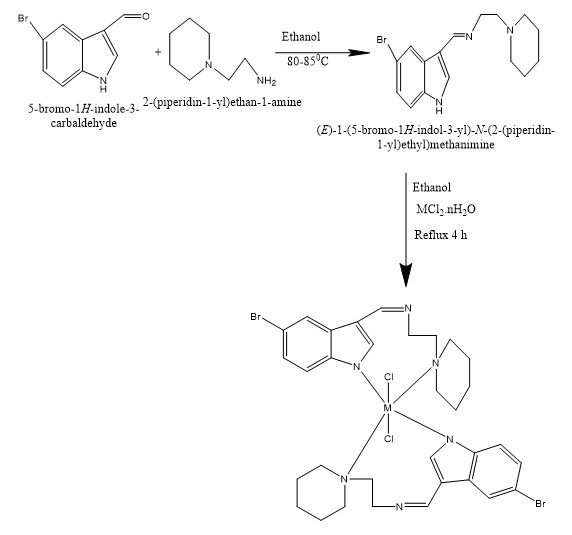
Objective: Schiff bases derived from indole frameworks have gained significant attention in medicinal and coordination chemistry due to their versatile donor sites and biological relevance. Their metal complexes often exhibit enhanced pharmacological properties through chelation, which improves lipophilicity and cellular permeability. However, despite their potential, only a limited number of studies have explored the antimicrobial properties of indole-based Schiff base complexes, especially those incorporating Ni(II), Co(II), and Cr(II). Therefore, this research focuses on synthesizing, characterizing, and evaluating new complexes of these metals to help bridge this gap. Methods: In this study, a Schiff base ligand, (E)-1-(5-bromoindolin-3-yl)-N-(2-(piperidin-1-yl) ethyl) methanimine (L1), was synthesized from 5-bromoindole-3-carbaldehyde and 1-(2-aminoethyl)piperidine in an ethanolic medium. Its Cr (II), Co (II), and Ni (II) complexes were prepared by refluxing the ligand with the corresponding metal chlorides. The compounds were characterized using FTIR, UV–Vis spectroscopy, molar conductance, and magnetic susceptibility measurements. Their antimicrobial and antifungal activities were evaluated against Staphylococcus aureus, Klebsiella pneumoniae, Aspergillus niger, and Candida albicans. Results: Spectroscopic and magnetic data confirmed octahedral coordination involving the indole and piperidine. The metal complexes showed higher thermal stability and molar conductance values indicative of [ML]Cl₂ electrolytic structures. Antimicrobial assays revealed improved activity of the complexes compared to the free ligand, particularly the Cr (II) and Ni (II) complexes, which exhibited notable inhibitions against S. aureus and A. niger. Conclusion: The study demonstrates that complexation of indole-based Schiff bases with transition metals enhances their physicochemical and biological properties. These findings support the potential of such metal complexes as promising antimicrobial agents and a foundation for designing therapeutic compounds.
References
Adhao, S. T., & Wagh, R. R. (2024). Synthesis, spectral, thermal studies and antimicrobial evaluation of transition metal complexes with novel Schiff base ligand. Oriental Journal of Chemistry, 40(1), 142–151. https://doi.org/10.13005/ojc/400118
Akash, M. S. H., & Rehman, K. (2019). Ultraviolet-visible (Uv-vis) spectroscopy. In M. S. H. Akash & K. Rehman, Essentials of Pharmaceutical Analysis (pp. 29-56). Springer Nature Singapore. https://doi.org/10.1007/978-981-15-1547-7_3
Asatkar K, A., Tripathi, M., & Asatkar, D. (2020). Salen and related ligands. In A. Nanda Srivastva (Ed.), Stability and Applications of Coordination Compounds. IntechOpen. https://doi.org/10.5772/intechopen.88593
Bandgar, B. P., Patil, S. A., Gacche, R. N., Korbad, B. L., Hote, B. S., Kinkar, S. N., & Jalde, S. S. (2010). Synthesis and biological evaluation of nitrogen-containing chalcones as possible anti-inflammatory and antioxidant agents. Bioorganic & Medicinal Chemistry Letters, 20(2), 730-733. https://doi.org/10.1016/j.bmcl.2009.11.068
Chandra, S., Tyagi, M., Rani, S., & Kumar, S. (2010). Lanthanide complexes derived from hexadentate macrocyclic ligand: Synthesis, spectroscopic and thermal investigation. Spectrochimica Acta Part A: Molecular and Biomolecular Spectroscopy, 75(2), 835-840. https://doi.org/10.1016/j.saa.2009.12.009
Chandra, S., Verma, S., Dev, U., & Joshi, N. (2009). Tetraaza macrocyclic complexes: Synthesis, spectral and antimicrobial studies. Journal of Coordination Chemistry, 62(8), 1327-1335. https://doi.org/10.1080/00958970802521076
Geary, W. J. (1971). The use of conductivity measurements in organic solvents for the characterisation of coordination compounds. Coordination Chemistry Reviews, 7(1), 81-122. https://doi.org/10.1016/S0010-8545(00)80009-0
Hamad, M., Al-Marzooq, F., Srinivasulu, V., Sulaiman, A., Menon, V., Ramadan, W. S., El-Awady, R., & Al-Tel, T. H. (2024). Antimicrobial activity of nature-inspired molecules against multidrug-resistant bacteria. Frontiers in Microbiology, 14, 1336856. https://doi.org/10.3389/fmicb.2023.1336856
Juyal, V. K., Thakuri, S. C., Panwar, M., Rashmi, Prakash, O., Perveen, K., Bukhari, N. A., & Nand, V. (2024). Manganese(II) and Zinc(II) metal complexes of novel bidentate formamide-based Schiff base ligand: Synthesis, structural characterization, antioxidant, antibacterial, and in-silico molecular docking study. Frontiers in Chemistry, 12, 1414646. https://doi.org/10.3389/fchem.2024.1414646
Kilic, A., Tas, E., Deveci, B., & Yilmaz, I. (2007). Synthesis, electrochemical and in situ spectroelectrochemical studies of new transition metal complexes with two new Schiff-bases containing N2O2/N2O4 donor groups. Polyhedron, 26(14), 4009-4018. https://doi.org/10.1016/j.poly.2007.05.013
Kargar, H., Ashfaq, M., Fallah-Mehrjardi, M., Behjatmanesh-Ardakani, R., Munawar, K. S., & Tahir, M. N. (2022). Synthesis, crystal structure, spectral characterization, theoretical and computational studies of Ni(II), Cu(II) and Zn(II) complexes incorporating Schiff base ligand derived from 4-(Diethylamino)salicylaldehyde. Inorganica Chimica Acta, 536, 120878. https://doi.org/10.1016/j.ica.2022.120878
Malav, R., & Ray, S. (2025). Recent advances in the synthesis and versatile applications of transition metal complexes featuring Schiff base ligands. RSC Advances, 15(28), 22889-22914. https://doi.org/10.1039/D5RA03626G
Mana Edor, J., Cassiem Joseph, M., Jordaan, J. H. L., Vosloo, H. C. M., & Swarts, A. J. (2025). Synthesis, characterisation, and coordination behaviour of novel pyridyl‐formamidine based mn(I), cu(II), zn(II), and pd(II) complexes. European Journal of Inorganic Chemistry, 28(2), e202400585. https://doi.org/10.1002/ejic.202400585
Marinova, P. E., & Tamahkyarova, K. D. (2025). Synthesis, investigation, biological evaluation, and application of coordination compounds with schiff base—A review. Compounds, 5(2), 14. https://doi.org/10.3390/compounds5020014
Oruma, U. S., Ukoha, P. O., Ukwueze, N. N., Ekowo, L. C., Amalunweze, A. E., & Okafor, S. N. (2024). Synthesis, biological and in silico studies of (1H-Indol-3-ylmethylene)-naphthalen-1-ylamine and its Os(VIII), Pd (II), Ni(II), Cr (III) and Fe(III) complexes. Oriental Journal of Chemistry, 40(6), 1715-1722. http://dx.doi.org/10.13005/ojc/400624
Rajasekar, M., Mary, J., Sivakumar, M., Ravichandran, S. S., & Srinivasan, D. (2025). Recent advances in organic fluorophore-based Schiff base metal complexes: Applications in biomedicine and related fields. Results in Chemistry, 15, 102166. https://doi.org/10.1016/j.rechem.2025.102166
Regueiro, A., García-López, V., Forment-Aliaga, A., & Clemente-León, M. (2024). Chiral spin-crossover complexes based on an enantiopure Schiff base ligand with three chiral carbon centers. Dalton Transactions, 53(25), 10637-10643. https://doi.org/10.1039/D4DT00924J
Shakir, Mohd., Kushwaha, S. K., Maurya, K. K., Bhagavannarayana, G., & Wahab, M. A. (2009). Characterization of ZnSe nanoparticles synthesized by microwave heating process. Solid State Communications, 149(45–46), 2047-2049. https://doi.org/10.1016/j.ssc.2009.08.021
Suemitsu, Y., Amakusa, Y., Yoshino, H., Ohba, M., & Koikawa, M. (2024). Slow magnetic relaxation in a [Co4O4] cubane complex with tridentate NNO-schiff base ligands. Magnetochemistry, 10(11), 85. https://doi.org/10.3390/magnetochemistry10110085
Sulaiman, Zainab & Umar, A. (2023). Synthesis, Characterization and in vitro Antimicrobial Studies of Schiff Bases Derived From Some Selected Amino Acids and Indole-3-Carbazaldehyde. Bayero Journal of Pure and Applied Sciences, 14, 87-93.
Sunjuk, M., Al-Najjar, L., Shtaiwi, M., El-Eswed, B., Sweidan, K., Bernhardt, P., Zalloum, H., & Al-Essa, L. (2023). Metal complexes of schiff bases prepared from Quinoline-3-Carbohydrazide with 2-Nitrobenzaldehyde, 2-Chlorobenzaldehyde and 2,4-Dihydroxybenzaldehyde: Structure and biological activity. Inorganics, 11(10), 412. https://doi.org/10.3390/inorganics11100412
Takeda, C., Nakane, D., & Akitsu, T. (2023). Recent advances in chiral Schiff base compounds in 2023. Molecules, 28(24), 7990. https://doi.org/10.3390/molecules28247990
Tuna Yıldırım, S. (2024). Synthesis and characterization of N2O2 type schiff base ligand with salicylaldehyde derivate and its metal complexes. Journal of the Turkish Chemical Society Section A: Chemistry, 11(3), 1091-1098. https://doi.org/10.18596/jotcsa.1405238